
What Is Engineered Stone? Types, Benefits, Applications & Price
- Chalcy Garg

- Jun 12
- 10 min read
Engineered stone has become one of the most popular surface materials for modern homes, commercial spaces, and luxury interiors due to its durability, low maintenance, and wide design variety. From engineered quartz countertops and composite stone surfaces to porcelain slabs, Nano White (G5/G7), sintered stone, and full-body tiles, engineered stone offers innovative alternatives to natural granite and marble. In this complete guide, you'll learn what engineered stone is, how it is made, the different types available, their benefits, applications, prices in India, and how to choose the best engineered stone for kitchen countertops, flooring, walls, and other interior projects.

What Is Engineered Stone?
Engineered stone is a manufactured surface material created by combining natural minerals, stone aggregates, pigments, and binding agents using advanced production technologies. Unlike natural stone, which is quarried directly from the earth, engineered stone is designed to deliver improved consistency, durability, and performance.
Today, engineered stone is widely used in kitchen countertops, bathroom vanities, flooring, wall cladding, staircases, commercial interiors, and outdoor applications. The category includes engineered quartz, composite stone, porcelain slabs, sintered stone, nano white surfaces, and full-body vitrified slabs.
Why Is Engineered Stone Becoming So Popular?
Homeowners, architects, and interior designers increasingly prefer engineered stone because it solves many of the limitations associated with natural stone.
Key Reasons for Its Popularity
Consistent appearance and color
Low porosity and stain resistance
Better durability than many natural materials
Large-format slab availability
Easy maintenance
Suitable for kitchens, bathrooms, flooring, and walls
Long-term value for residential and commercial projects
Top Types of Engineered Stone Used for Countertops, Flooring & Interior Applications
Here is the list of the most popular engineered stone materials used in residential and commercial projects:
Engineered Quartz
Composite Stone
Nano White Stone
Full Body Tile
Porcelain Slabs
Sintered Stone
Engineered Marble
Terrazzo Stone
How Is Engineered Stone Manufactured?
The manufacturing process varies depending on the material type, but most engineered stones are produced using advanced compression, vibration, sintering, or crystallization technologies.

Typical manufacturing steps include:
Selection of raw minerals
Crushing and grading
Mixing with pigments and binders
Compression under high pressure
Heat curing or sintering
Surface polishing and finishing
Quality inspection
The result is a highly engineered surface designed to offer superior performance compared to many traditional materials.
Types of Engineered Stone

Engineered stone is not a single product. It is a broad category containing several different surface technologies.
1. Engineered Quartz Stone
Engineered quartz stone is the most widely used engineered stone for kitchen countertops. It combines natural quartz crystals with resin binders and pigments to create durable, non-porous surfaces.
Applications
Kitchen countertops
Kitchen islands
Bathroom vanity tops
Reception counters
Commercial workstations
Benefits
Excellent stain resistance
Easy cleaning
Consistent designs
Wide color selection
Low maintenance
2. Composite Stone
Composite stone refers to surfaces produced by combining natural stone aggregates with resin or cement-based binders. Engineered quartz and engineered marble are common examples.
Applications
Flooring
Countertops
Wall cladding
Commercial interiors
Benefits
Improved consistency
Better durability
Cost-effective alternative to natural stone
3. Engineered Marble
Engineered marble is manufactured using crushed marble particles mixed with resin binders.
Applications
Indoor flooring
Wall panels
Bathrooms
Hotels and commercial projects
Benefits
Luxurious appearance
Uniform patterns
Lower cost than premium natural marble
4. Porcelain Slabs
Porcelain slabs are manufactured using refined minerals fired at extremely high temperatures.
Applications
Kitchen countertops
Outdoor kitchens
Building facades
Flooring
Wall cladding
Benefits
Exceptional heat resistance
UV resistance
Scratch resistance
Suitable for outdoor environments
5. Sintered Stone
Sintered stone is produced by exposing natural minerals to extreme pressure and heat, replicating the natural stone formation process.
Applications
Luxury countertops
Exterior cladding
Outdoor kitchens
Commercial interiors
Benefits
Extremely durable
UV stable
Heat resistant
Low maintenance
6. Nano White Stone (G5 & G7)
Nano White, often marketed as G5 or G7 stone, is a crystallized glass-based engineered surface known for its bright white appearance.
Applications
White kitchen countertops
Luxury flooring
Staircases
Feature walls
Benefits
Ultra-white appearance
High gloss finish
Excellent stain resistance
7. Full-Body Tiles
Full-body vitrified slabs and tiles are engineered surfaces where the color and design run through the entire thickness.
Applications
Commercial flooring
Residential flooring
Retail spaces
Airports
High-traffic areas
Benefits
Excellent wear resistance
Durable construction
Consistent appearance
Which Engineered Stone Is Best?
The best engineered stone depends on the intended application:
Surface Type | Heat Resistance | Stain Resistance | Maintenance | Best For |
Engineered Quartz | High | Excellent | Low | Kitchen Countertops |
Composite Stone | Moderate | Good | Low | General Interiors |
Engineered Marble | Moderate | Good | Moderate | Flooring & Walls |
Porcelain Slabs | Excellent | Excellent | Very Low | Indoor & Outdoor Use |
Sintered Stone | Excellent | Excellent | Very Low | Luxury Projects |
Nano White (G5/G7) | High | Excellent | Low | Premium White Interiors |
Full-Body Tiles | Excellent | Excellent | Very Low | Flooring Applications |
For most homeowners, engineered quartz remains the preferred choice for kitchen countertops due to its balance of durability, aesthetics, and low maintenance. For outdoor applications and extreme heat resistance, porcelain slabs and sintered stone are often considered superior alternatives.
Where Should You Use Different Types of Engineered Stone?
Not all engineered stones are designed for the same applications. Some materials perform exceptionally well in kitchens, while others are better suited for outdoor spaces, wall cladding, or flooring. Understanding the strengths and limitations of each surface can help homeowners, architects, and interior designers choose the right material for their project.
Engineered Stone Type | Best Applications | Not Recommended For |
Engineered Quartz | Kitchen countertops, kitchen islands, bathroom vanity tops, dining tables, office worktops, reception counters | Outdoor kitchens, exterior applications, fireplace surrounds exposed to extreme heat, direct UV exposure |
Porcelain Slabs | Outdoor kitchens, dining tables, bathroom counters, wall cladding, flooring, facades, indoor and outdoor applications | Heavy fabrication projects with complex edge profiles, primary kitchen countertops where impact resistance is a top priority |
Nano White (G5/G7) | Kitchen countertops, bathroom vanity tops, flooring, indoor applications, selected outdoor applications, dining tables | Building elevations, exterior facades exposed to structural movement, large unsupported installations |
Full-Body Tiles | Building elevations, wall cladding, flooring, balconies, terraces, small countertops, outdoor applications, commercial spaces | Large seamless kitchen countertops, waterfall islands, premium luxury countertops requiring thick slab fabrication |
Engineered Marble | Indoor flooring, bathroom walls, decorative wall panels, commercial interiors | Outdoor installations, high-use kitchen countertops, heavy-duty work surfaces |
Sintered Stone | Outdoor kitchens, facades, wall cladding, dining tables, luxury countertops, flooring, commercial projects | Applications requiring extensive on-site modifications without specialized fabrication equipment |
Expert Recommendation for Countertops
If your primary goal is a long-lasting kitchen countertop, engineered quartz is generally considered one of the best options due to its durability, stain resistance, low maintenance, and wide range of designs. Porcelain slabs and sintered stone are excellent alternatives for outdoor kitchens and heat-intensive environments, while Nano White surfaces are often selected for bright white modern interiors. Full-body tiles can be used for small counters and utility areas but are generally less preferred for large premium kitchen countertops compared to quartz slabs.
Engineered Stone vs Natural Stone

Feature | Engineered Stone | Natural Stone |
Appearance | Consistent | Unique Natural Patterns |
Porosity | Low | Moderate to High |
Maintenance | Low | Moderate |
Stain Resistance | Excellent | Varies |
Color Uniformity | Excellent | Limited |
Availability | High | Depends on Quarry |
Cost Predictability | High | Variable |
Granite remains a popular natural stone, but engineered stone offers several advantages.
Engineered Stone Advantages
More consistent designs
Better stain resistance
Lower maintenance
Larger design options
Granite Advantages
Natural uniqueness
Excellent heat resistance
Outdoor suitability
For most modern kitchens, engineered quartz countertops are often preferred because of their easy maintenance and consistent appearance.
Engineered Stone vs Marble
Marble is known for luxury and elegance, while engineered stone focuses on performance.
Feature | Engineered Stone | Marble |
Stain Resistance | Excellent | Moderate |
Maintenance | Low | High |
Durability | High | Moderate |
Cost | Predictable | Variable |
Engineered Stone vs Porcelain
Both materials are highly durable.
Choose Engineered Quartz If:
You prioritize countertop aesthetics
You want a warmer surface feel
You need low maintenance
Choose Porcelain If:
You need outdoor applications
You want maximum heat resistance
UV exposure is expected
Advantages of Engineered Stone
Exceptional Durability
Engineered stone is designed to withstand daily wear and tear.
Low Maintenance
Most engineered surfaces require only simple cleaning.
Stain Resistance
Non-porous surfaces help prevent stains from food and liquids.
Design Variety
Available in marble-look, concrete-look, granite-look, and modern designs.
Long-Term Value
Engineered stone can maintain its appearance for many years with proper care.
Disadvantages of Engineered Stone
While engineered stone offers many benefits, buyers should understand its limitations.
Some products may be sensitive to extreme heat.
Professional fabrication is usually required.
Certain resin-based materials are less suitable for outdoor UV exposure.
Quality varies between manufacturers.
Applications of Engineered Stone
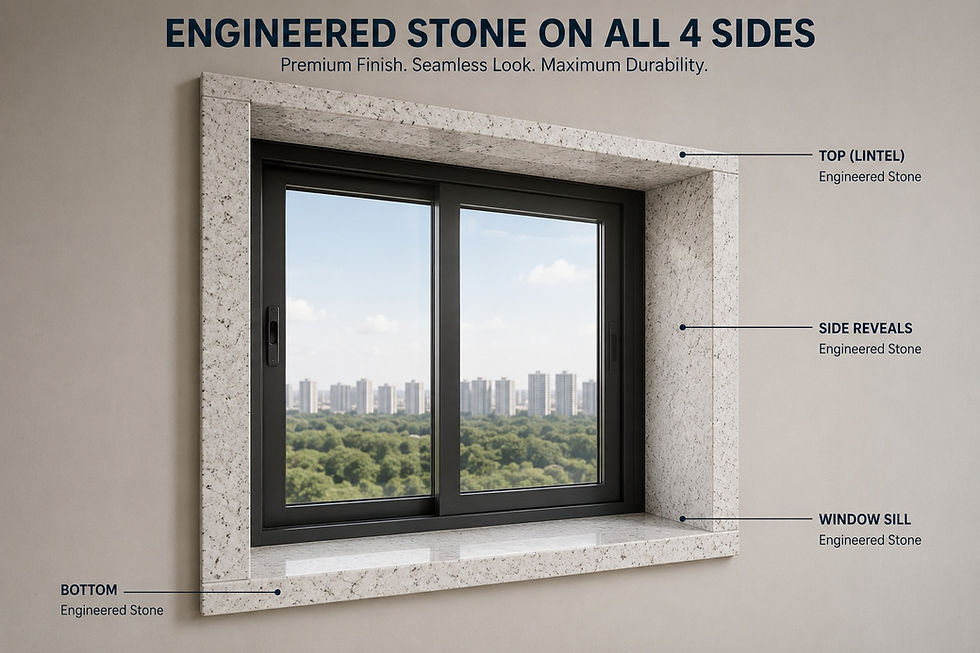
Kitchen Countertops
The most common application worldwide.
Bathroom Vanities
Popular due to moisture resistance.
Flooring
Widely used in residential and commercial spaces.
Wall Cladding
Provides modern and luxurious aesthetics.
Staircases
Offers durability and visual appeal.
Commercial Interiors
Hotels, offices, malls, and restaurants increasingly use engineered stone surfaces.
Engineered Stone Price in India
Prices vary significantly depending on the material type, thickness, design complexity, and brand.
Typical Price Range
Material | Approximate Price Range |
Engineered Quartz | ₹350–₹1,500+ per sq. ft. |
Porcelain Slabs | ₹300–₹1,200+ per sq. ft. |
Nano White | ₹450–₹800+ per sq. ft. |
Full-Body Tiles | ₹100–₹350+ per sq. ft. |
Sintered Stone | ₹500–₹2,500+ per sq. ft. |
Top Engineered Stone Brands by Surface Category
The engineered stone industry includes several surface technologies, each with specialized manufacturers known for quality, innovation, and performance. Whether you're looking for engineered quartz countertops, porcelain slabs, or full-body tiles, choosing a reputable brand can significantly impact durability, aesthetics, and long-term value.
Engineered Stone Category | Top Brands |
Engineered Quartz | Relay Stone, Caesarstone, HFH Quartz, Silestone, Hafele Terra |
Porcelain Slabs | Stonelam, Neolith, Simpolo |
Full-Body Tiles | Somany, Kajaria, Orientbell, Johnson Tiles, Asian Granito (AGL) |
Engineered Marble | Johnson Marble & Quartz, Elegant Marbles, Classic Marble Company (CMC) |
Sintered Stone | Neolith, Lapitec, Laminam, Stonelam |
Nano White (G5/G7) | Various imported and domestic manufacturers available across India |
Which Engineered Stone Brand Is Best?
The best engineered stone brand depends on the application. For kitchen countertops, brands such as Relay Stone, Caesarstone, HFH Quartz, Silestone, and Hafele Terra are widely preferred for their durability, stain resistance, and modern designs. For large-format wall cladding and outdoor applications, porcelain slab brands like Stonelam, Neolith, and Simpolo are popular choices. Meanwhile, Kajaria, Somany, Orientbell, Johnson Tiles, and AGL remain among the leading manufacturers of full-body vitrified tiles for residential and commercial flooring projects.

Best Engineered Stone for Kitchens
When it comes to kitchen countertops, engineered quartz is widely regarded as the best engineered stone because it offers the perfect balance of beauty, durability, and ease of maintenance.
Why Quartz Is the Best Engineered Stone for Kitchens
Excellent stain resistance – Resists common kitchen spills such as oil, tea, coffee, turmeric, and sauces.
Non-porous surface – Does not absorb moisture, making it hygienic and easy to clean.
Low maintenance – No regular sealing or special treatments required.
Highly durable – Designed to withstand daily cooking activities and heavy use.
Wide range of designs – Available in marble-look, concrete-look, solid colors, and premium designer patterns.
Consistent appearance – Uniform color and veining throughout the slab.
Ideal for modern kitchens – Perfect for modular kitchens, island countertops, breakfast counters, and dining tables.
Long-lasting investment – Maintains its appearance and performance for many years.
Recommended Quartz Brands
Relay Stone
Caesarstone
HFH Quartz
Silestone
Hafele Terra
For homeowners looking for a premium kitchen countertop, Relay Stone Quartz combines elegant designs, advanced manufacturing technology, and dependable performance, making it a popular choice for modern Indian kitchens.
Choosing the Right Engineered Stone
Before selecting a material, consider:
Usage requirements
Budget
Design preference
Indoor or outdoor installation
Maintenance expectations
Fabrication availability
A well-selected engineered stone surface can enhance both functionality and aesthetics for years to come.
Conclusion
Engineered stone has transformed the modern surface industry by offering durable, attractive, and low-maintenance alternatives to traditional natural stone. Whether you choose engineered quartz, composite stone, porcelain slabs, sintered stone, nano white surfaces, or full-body tiles, each material offers unique advantages for different applications.
Understanding the differences between these engineered surface technologies allows homeowners, architects, and builders to make informed decisions based on performance, aesthetics, and budget. As construction and interior design continue to evolve, engineered stone is expected to remain one of the most important materials for kitchens, bathrooms, flooring, and commercial interiors worldwide.
Frequently Asked Questions (FAQs)
What are the different types of engineered stone?
There are several types of engineered stone available for residential and commercial applications. The most popular options include:
Quartz Stone – Made from natural quartz combined with resins and pigments.
Composite Stone – Manufactured using a blend of natural stone aggregates and binding materials.
Nano White Stone – A highly polished engineered surface known for its bright white appearance.
Full Body Tile – Engineered slabs with consistent color and pattern throughout the material.
Porcelain Slabs – High-density engineered surfaces produced under extreme heat and pressure.
Each type offers different advantages in terms of appearance, durability, maintenance, and application.
What is engineered stone?
Engineered stone is a man-made surface material created by combining natural stone particles, minerals, pigments, and resins under controlled manufacturing conditions. It is designed to provide superior consistency, durability, and aesthetic appeal compared to many natural stones.
Is engineered stone good quality?
Yes. High-quality engineered stone offers excellent strength, stain resistance, scratch resistance, and design consistency. Premium engineered stone products are widely used for kitchen countertops, bathroom vanities, window sills, wall cladding, flooring, and commercial interiors.
Is engineered stone better than granite?
Both materials have advantages. Engineered stone generally offers more consistent patterns, lower maintenance requirements, and better stain resistance. Granite is a natural stone with unique variations and excellent heat resistance. Many homeowners choose engineered quartz for modern kitchens because of its durability and ease of maintenance.
What is an example of engineered stone?
Common examples of engineered stone include quartz countertops, composite stone surfaces, porcelain slabs, nano white stone, and full-body engineered slabs used in kitchens, bathrooms, and commercial projects.
Is granite or engineered stone cheaper?
Pricing depends on the quality, thickness, design, and brand. Entry-level granite can sometimes be less expensive than premium engineered stone. However, many engineered stone products offer better long-term value due to lower maintenance requirements and consistent quality.
What are the disadvantages of engineered stone?
Some engineered stone products may:
Have lower heat resistance than natural granite.
Require professional installation due to their weight.
Be more expensive than entry-level natural stone options.
Show damage if exposed to excessive direct heat without protection.
Choosing a reputable manufacturer helps minimize these concerns.
Which engineered stone is the best?
Quartz is widely considered one of the best engineered stone materials because it combines durability, stain resistance, low maintenance, and a wide variety of designs. Premium quartz surfaces are among the most popular choices for modern kitchens and luxury interiors.
Which is more expensive, engineered quartz or granite?
The cost varies by quality and design. Premium engineered quartz and premium granite often fall within a similar price range. Designer quartz slabs with intricate veining patterns can sometimes cost more than standard granite, while basic quartz products may be comparable to mid-range granite options.
What is the highest quality stone?
The highest-quality stone depends on the application. For kitchen countertops, premium engineered quartz is often considered one of the best choices because it offers exceptional durability, low maintenance, stain resistance, and consistent aesthetics. High-grade granite and porcelain slabs are also regarded as premium surface materials for residential and commercial projects.


Comments